Pages

Showing posts with label Bioshock. Show all posts

Wednesday, 3 April 2013

Bioshocked

As you likely saw, there was no blog last week, because I'd done something amazing. I preordered a game to pick up on release day. Specifically I preordered Bioshock Infinite. This is a significant occurrence, it's the first game I've actually gone out and ordered since Final Fantasy VIII, which was also, incidentally, the one time I've ever gone out of my way to get the collectors edition of a game. Anyway, the stars aligned for me on the runup to Bioshock Day. I got some interest on my savings the week before release, and the review on IGN appeared a couple of days after that. The score was amazing so I ordered.

I was slightly thrown by the actual release day. When did games start being released on a Tuesday? I've clearly missed something here. I thought games got released on a Friday so you can ignore all your friends and play all weekend. Not anymore it seems! Nevertheless, it was fortunate that I also had release day off. I played all day, again, something I don't do often. It was wonderful.

If you haven't played it yet, I urge you to do so. Go out in your lunch hour, pick it up tomorrow. It doesn't matter what format you choose. It's beautiful in every possible way. It's light is blinding, it's colours deeply saturated. It animates beautifully. Columbia feels lived in, a world held up by the sheer force of belief of it's inhabitants. The voice acting is stellar. The use of it's licensed music is unique. Elizabeth is utterly, utterly wonderful, the most believable AI companion I've seen since Alyx Vance. She will stir genuine emotions in you. The villains are memorable and the Songbird is terrifyingly powerful. Best of all, the story is fabulously dense, covering a myriad of themes, building to a melon twisting gut punch of an ending. Basically I'm saying if you don't play this, you are missing out on what will probably be the best release of this year and in all likelihood the best game of this console generation.

The first thing I wanted to do when I finished it was start it again.

There's so much buried in Columbia you'll never find everything on your first playthrough unless you use a guide. Do yourself a favour, play it like a real gamer and leave the guide in the shop. Take pleasure in the exploring, the discovery. If you buy a guide, you're basically buying spoilers, the screenshots will steal the
awe from every new area. I will be buying the other companion book however. The Art of Bioshock Infinite, a near 200 page hardcover full of concept art from the game. If you decide to do the same, wait til you finish the game. You don't want spoilers, the game has so much impact when you see it with fresh eyes. (Update: The book arrived today, and it's beautiful, chock full of amazing art. Best of all is the cover under the dust jacket, a shot of Elizabeth and the Songbird embossed in what might just be gold leaf. As you can probably tell, I'm very pleased with it. As a both fan of the game and a book nut, I can honestly say this is an essential purchase.)

So again. Buy Bioshock Infinite! It means Irrational Games will make a ton of money which they can plough into making Ken Levine's next opus. The world needs more games like this, and gaming as a whole needs more men like Ken Levine. He's like a gaming Chris Nolan, somehow making the unapologetically high concept suitable for the mass market. Just as film has it's easily recognisable auteurs, gaming is starting to gain a few of its own too.

Make sure you stay for the credits too, there's a nice little surprise from around the midpoint.

Now go buy it!

Wednesday, 13 March 2013

How to end the curse of Bad Game Movies

Despite the (perhaps contentious) exceptions of Prince of Persia and the first Silent Hill, it has become an accepted truth that movies of games are universally awful. You only need to clap eyes on the litany of failed adaptions to see that this is true. Illustrious names like Super Mario Bros, Doom, Max Payne, Final Fantasy, Hitman, Resident Evil, the entire output of the director Uwe Boll. All movies based on great games, all varying in quality from bad (Resident Evil), to so awful that the world is a slightly worse place due to their existence (the entire output of the director Uwe Boll).

I've come to realise it doesn't have to be this way. The way I got to this point is long and winding, a bit like the plot of the literary adaption that helped form this theory. But bear with me.

The Lord of the Rings. Three films. 654 minutes. Coming up to 11 hours. Far. Too. Damn. Long. For a film at least. I've famously bitched about this in real life many times before. There is way too much content in The Lord of the Rings novels to squeeze into three films with acceptable runtimes. It is however, the perfect runtime for a TV series. I only realised this after watching through the Death Note box set. It's a literary adaption that really benefits from the long form of a TV series. Now I'm not saying LotR would make for a good TV series, but HBO's recent mega budget adaption of Game of Thrones, which I've moved on to post Death Note, shows that a really sizable story can be successfully adapted to the small screen.

In separate, yet related events, a recent pub conversation quickly degenerated into the cartoons we watched as kids. Unconditional love and praise was lavished upon the Adventures of Sonic the Hedgehog and Earthworm Jim. There were also fond memories of the Super Mario World and Legend of Zelda cartoons that showed in the half term holidays while we were at school. Something along the lines of, "If they could get it right with these, why can't Hollywood get videogame movies right?" was said. There was some metaphorical beard stroking, then we shut up and got more beers in.

Whilst I was nursing the inevitable hangover, I had an epiphany.

This is where Hollywood has been going wrong with games. They're making movies. Think about it. A decent game is typically over ten hours long. If it's well written, the story will be designed to fit into that runtime. Far too much content to squeeze into a movie of respectable length. Videogame movies typically fail on story, either by compressing a story so much as to miss some of the key beats or by adapting a title with a plot so sparse that there's little in the way of structure holding the movie together. A long form adaption, such as a high budget TV series in the vein of Band of Brothers or Game of Thrones, or a miniseries such as the well received Dune would be the way to go.

So first of all the game you choose to adapt needs an exemplary story. Anything less won't work. A lot of game movies fall at the first hurdle with this. The story of the game is too sparse, so the script writers Make Shit Up to fill in the gaps, which inevitably ends in a disjointed film. Second, you need the original writer of the game in question on board. Part of the reason Game of Thrones works so well is because George RR Martin is involved in the production. It helps keep the adaption faithful to the novels, to realise the setting and makes sure that any changes in the story fit smoothly. Changes to certain in game events will be necessary to make a game's plot flow properly in a non interactive medium.

Let's take Spec Ops: The line as our hypothetical video game TV adaption. The following paragraph is highly idealised and probably in no way similar to the way a major TV production is brought about. But for the sake of this little thought experiment, let's say it is. By some miracle HBO have optioned the game for a series. They've given it a substantial budget, have the original writer on board and the production team behind a notable Iraqi war film. For the sake of example, let's use The Hurt Locker. The production team like the themes the game presents and want to remain as faithful as they can to the story of the game, but need to cut some of the many firefights to maintain the flow of the episode. However, cutting the firefights down to the major setpiece battles shortens the runtime of the final product, so that it doesn't fill it's projected ten episode run. So we need extra story, and here's where having the original author on board is important. Where a screenwriter coming from outside the original story would firmly be in Make Shit Up territory at this point, the original author would probably not be, having already made his shit up months or years in advance. He likely has some material cut from the game that elaborates on the motivations of the trio of factions that are battling in post apocalypse Dubai. So in place of the cut firefights, we now get scenes with the CIA working up the remaining civilian population and the private reaction of the Radioman to the carnage being caused all around him. The story is fleshed out, the situation for its protagonists gets even more FUBAR, the target runtime is reached and it hopefully knits together seamlessly because all of the additions have come from the mind of the person who conceived the story to begin with. All that remains is to film it. The production team decide to merge the formula of the seminal Band of Brothers with that of their own desert war movie and we have a series that might just work.

It's not a sure fire way to end the curse of the Bad Videogame Adaption, but it's perhaps the most feasible. And think of the possibilities it could unlock. Ponder for a moment, the potential of a series based on Mass Effect. While the intricacies of the choice based branching plot would have to be hammered out, it could still be the first worthwhile space opera on TV since Firefly was cancelled. Of course, if you like your sci-fi a bit nastier, there's always Dead Space, with it's dense unitology backstory and its clever combination of the aesthetics of The Thing and Aliens.

Or how about an adaption of Sly Cooper. The game itself is basically Hustle with animals. A hand animated series where each episode is a heist tied together by an overarching plot would work beautifully. It's got it all. Daring stunts, outlandish baddies, high tech gadgets, a great buddy dynamic, and the simmering attraction between Carmelita Fox and Sly. Stir in a splash of James Bond glamour and sprinkle liberally with the stolen essence of Aardman's ability to appeal to both adults and children and you have a surefire hit on your hands.

Bioshock could work nicely in both movie or TV format, depending on whether you wanted to film the first game, or the novel and both games. It would be expensive to implement and would need a bit of reworking but would be entirely worth it. On the surface, Bioshock is basically one man rampaging through a crumbling undersea city, listening to a voice on the radio, shooting the mad inhabitants and picking up audio logs. Not a very interesting concept for a TV show. Jack is a non character that only exists for the player to interact with the world, it's the story around him that makes Rapture so compelling a place to inhabit. So we make the story the focus. Instead of focussing on Jack, focus on the characters and the events that brought him to Rapture in the first place. Film the audio logs. Use an ensemble cast. Weave the resulting scenes together into a Pulp Fiction style tapestry bookended by Jack's arrival and departure from Rapture. Intersperse the tapestry with flashes of Jack being directed through Rapture by whoever has latched onto him at that segment of the story, Atlas, Ryan, whoever. It would be a difficult, yet absorbing picture, that would not only need the hand of Ken Levine, who recently killed a Bioshock movie project, but also a skilled and deft director to make sure the whole thing doesn't fall apart under the weight of its own ambition.

Hollywood execs rightly see the videogame world as ripe for movie adaptions, it's just a shame that most of the time they're the wrong people looking at them. TV execs that should be approaching the major game studios as well. In addition to this, the studios need to make sure that they retain creative control of the property being adapted, so that the vision of the original game isn't compromised by the transition to celluloid. This is something Ubisoft have already learned. They are about to make their first foray into feature film with Assassin's Creed, in which Michael Fassbender is rumoured to be starring. If I can see what needs to be done, then it really can't be that hard, can it?

Assassins Creed is another title I think would work better as TV series, given the scale of it's vision. But hopefully the powerhouse that is Ubisoft can end the curse of the Bad Game Movie and produce a good film. All the ingredients are there, and if they can't, then there's really no hope of ending the curse at all is there?

Wednesday, 12 December 2012

An Honorable Mention


I did something amazing the other day, I finished a game less than six months old. I’m usually way behind with playing the latest releases, simply because it’s hard to find the time to play them all, but I saw Dishonored at half price, and well, you can’t pass up an offer like that can you?

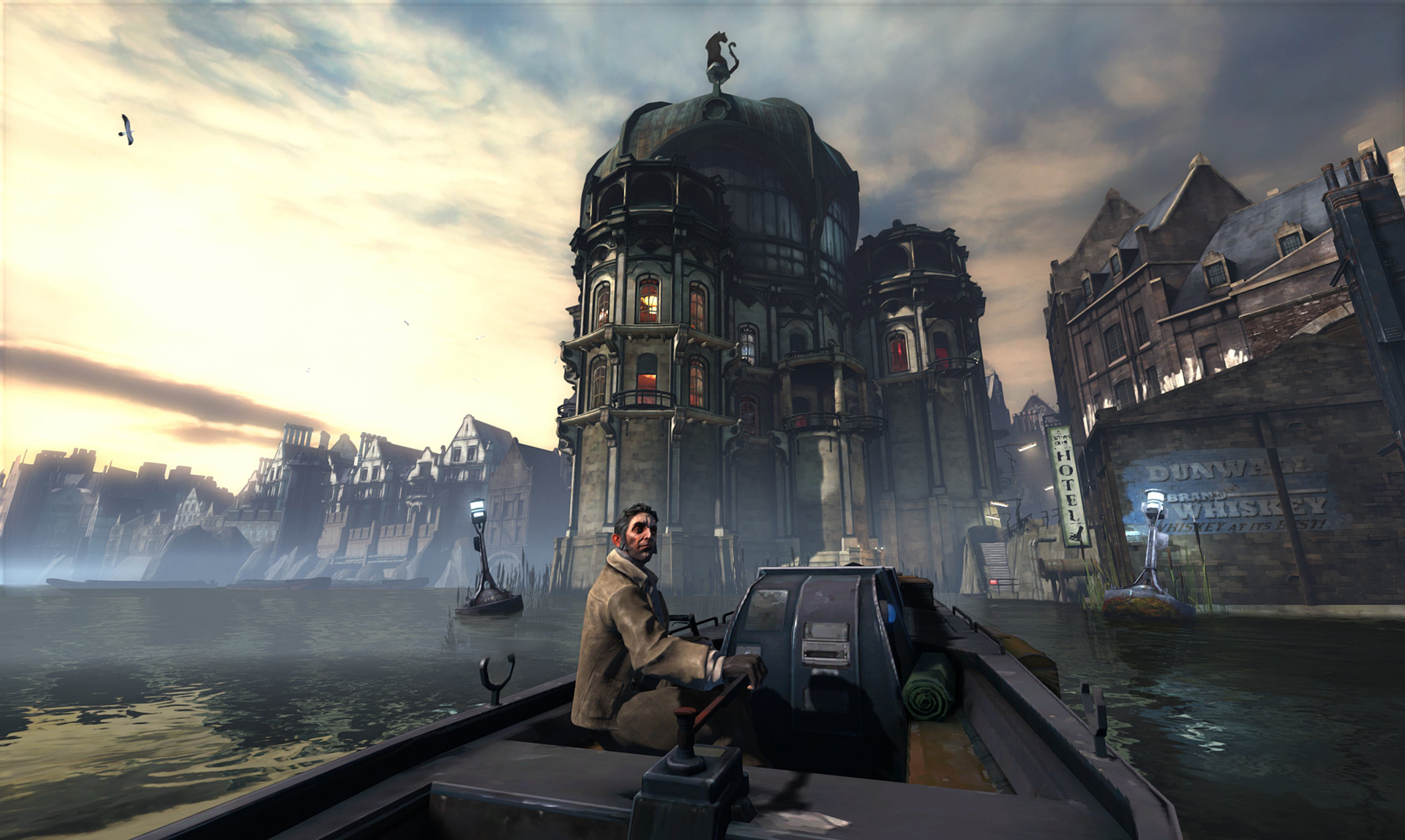
I have to say I’m really, really impressed with Dishonored, both with the game itself and the developers for taking a chance on an ambitious new IP like this. It’s that rarest of beasts, a single player only adventure and a new name on the shelf. And while Dishonored is not quite a masterpiece, I thoroughly enjoyed every minute I spent in the whalerpunk city of Dunwall. After Fable’s Albion, Dunwall is the most English feeling fantasy world I’ve ever set foot in, game, book or movie. It feels like a hyper industrialised Dickensian London, complete with rats, dingy alleys, an uncaring aristocracy and English accents throughout. A fact made even more astounding when you discover that Dunwall’s creators, Arkane Studios, are French.

I say all the time that a great setting helps to make a great game, and it seems that Arkane agree with me. Advertisements for refined whale oil and whiskey are posted to the sides of houses. Propaganda booms over the loudspeakers. Notices about tax and the rat plague appear on street corners, and there is art everywhere. Landscapes of Dunwall, images of whaling ships, portraits of the great and good of the aristocracy pepper abandoned and flooded mansions, and in the Golden Cat , a ‘bathhouse’, portraits of women of ill repute dominate the walls. The art is universally fantastic too. I found myself stopping to get a closer look at many of the paintings I passed on my way through the game. Also scattered around the city are notes and books that help flesh out the history and culture of Dunwall. They can range from the lyrics of “What shall we do with the Drunken Whaler,” to excerpts from plays, to notes on the occult, to Bioshock style audiologs. You can see all the thought and all the work that has gone into giving the game a sense of place. It all serves to make Dunwall feel less like a construction of polygons and textures and more like a lived in, and dying, city.

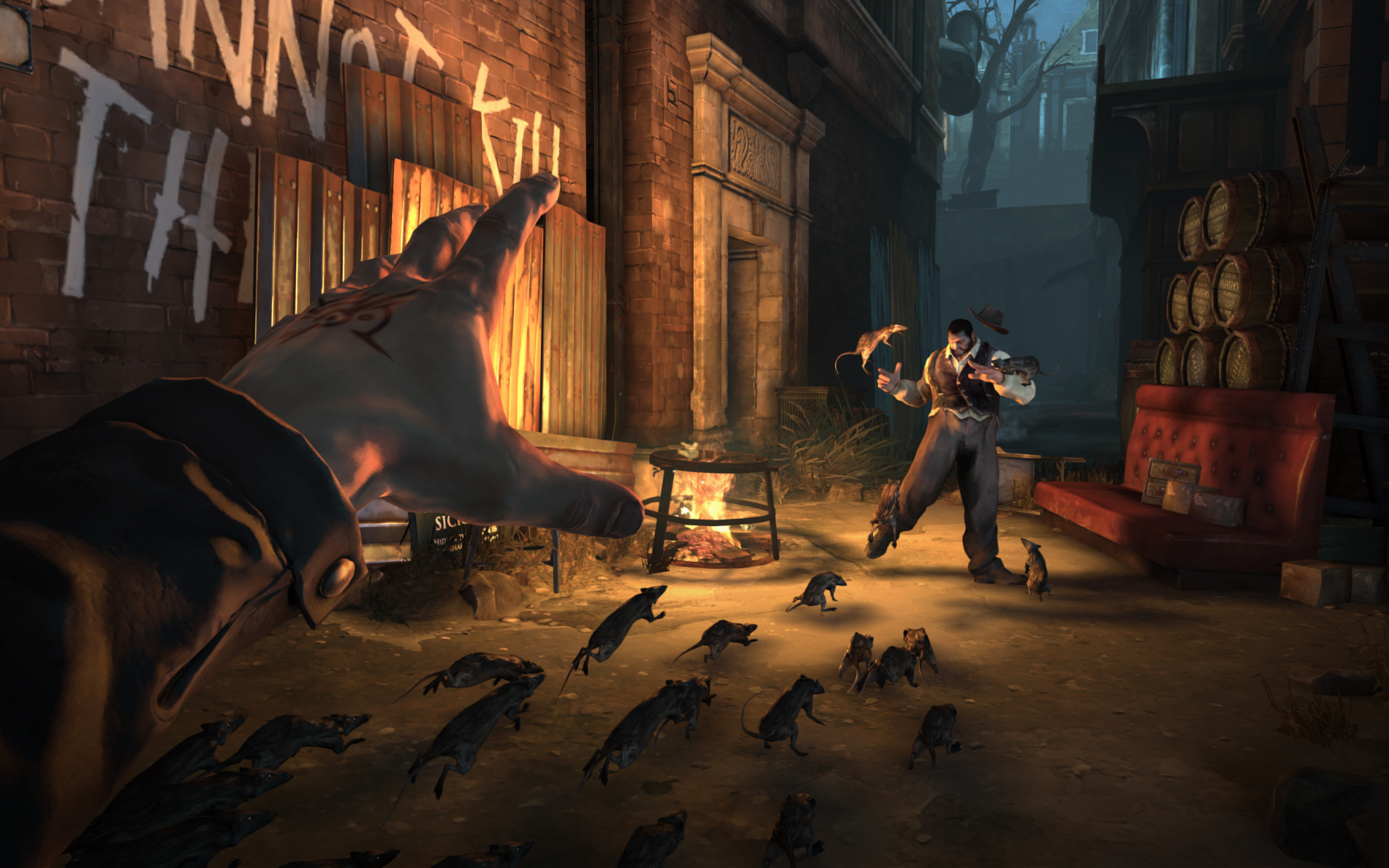
I get the feeling that Bioshock was quite the influence on Dishonored as it developed. From its first person viewpoint and watery setting, to a couple of pivotal game mechanics. Like Bioshock, the left and right triggers control your left and right hands. In your right hand is a fairly conventional sword. You swing it about in the conventional manner, stabbing people in the conventional way. To me, first person sword combat often never feels like much more than swinging your virtual arm around, hoping to hit something. In Dishonored, the sword combat is slightly better than that. Enemies react to where you hit them, and Corvo, the game’s lead, will often grab his assailants and execute them in a satisfyingly gruesome manner. The left hand is where the Bioshock influence comes. Corvo has supernatural powers, gained from collecting runes, and can augment his abilities with bone charms. Switch Runes for Adam, Bone charms for Gene Tonics and Powers for Plasmids and you will understand everything you need to know about what the left trigger controls. Even the health and mana bars in Dishonoured are the same colours as Bioshock’s health and Eve bars.

The powers aren’t a straight rip off though. Where Bioshock’s plasmids were mostly offensive, Dishonored’s powers are more neutral. They tend to be aimed at helping you traverse Dunwall as quickly and as silently as possible. Key abilities such as the short range teleport, time manipulation and the (brilliantly fun to unleash) Rat Swarm can be chained with offensive moves to create some really interesting and fun combat options. Personally, one of the reasons I’ll be replaying the game will be to experiment more with them.

I had a few minor gripes, the main one being that the game actively encourages a quicksave and retry style of play that might work fine on the PC but is a bit of a pain to do on my Xbox. Frequently flicking in and out of menus to save after a particularly difficult section really breaks the flow of the game and the it breaks the immersion too. I also would like to have been told that my style of play would affect how the game ended after I had finished the game. Being told this in the loading screens meant that I automatically held back on the carnage to make sure I got the good ending. After all, who doesn't like a good ending? I would have preferred to have been surprised. Really though, they are minor things and didn’t affect my enjoyment of the game so much as to ruin the experience. My main issue with Dishonored isn’t a gameplay issue at all. I found my immersion in the world Arkane have created was slightly broken by the wooden animation of the NPCs, particularly the facial animation. Okay, it's leagues better than the typical Bethesda dead from the jaw upwards work, and in freeze frame it can look quite good but it isn’t great, especially when you compare it to the stellar animation in games like Uncharted 3, Enslaved or Final Fantasy XIII. Hell, Portal 2’s personality cores were more expressionate than any character in Dishonored, and personality cores don’t even have faces.

Also, while I’m ranting. Why on earth is Corvo a silent protagonist? He clearly has a personality. You only have to look at the way he treats Emily to see that. He even has lines of dialogue, to a degree, in the options that flash up on screen when you interact with somebody. I would have felt more for Corvo, if he had a voice and a personality, if I understood his motivations and his relationships with the other members of the cast. Denying him a voice seems to be missing a trick. That said, the rest of the cast, and the excellent voice work provided for them, help to deliver a very enjoyable story. It’s simple, yet effective, with a satisfyingly organic and human final act. You can understand why the antagonist has done what he has.

All in all, despite the rant, Dishonored is a fabulous game. My issues may not necessarily be a problem for you, and in the grand scheme of things they aren't a problem for me either. I enjoyed every moment I spent in Dunwall and I’ve been recommending it to everyone I know who plays games. I’ll be playing it again, and I think I’d like to see a sequel too, if only to visit Dunwall again and see if Arkane have given Corvo a voice. 

Now, I'm finally going to get round to starting Bayonetta. I've only had it for six months...

Thursday, 29 November 2012

I only seem to be playing half of what I'm paying for.


I have a bit of a love hate relationship with online multiplayer. I do play online on occasion, yet I rarely touch the multiplayer component of most of the games I’ve gotten in this generation.

There. I’ve said it.

If I do go online I often find myself surrounded by idiots. A reason in itself to play in a closed party, but not the reason I don’t often mess with multiplayer. It’s because I find the multiplayer portion of most games to be entirely superfluous to the experience that I like to gain from singleplayer. Fair enough some games are built around their online component. For all my bitching about Call of Duty or Battlefield, the multiplayer portions are pretty damn good and are rightly lauded. I’m just turned off by some of the people who play it. Gears of War is fabulous online, as are Forza, PGR, Tekken and Left4Dead. But sometimes there is a multiplayer component added for seemingly no reason, except that the board of directors wanted it.

For instance, Bioshock.

I know this is just one example, but it’s the one that floats closest to the front of my mind. The first game was a wonderfully self contained experience, with a strong focus on narrative and on how you approach taking down your enemies. In short, my favourite kind of shooter. Best of all it was defiantly singleplayer. Why then, does Bioshock 2 have a multiplayer segment, complete with a half hearted attempt to meld it into the world by way of making it a Plasmid test? I bought Bioshock 2 to take another journey through Rapture. The thought of shooting other people online in that city at the bottom of the sea never once crossed my mind. I had visions of the nuance being sucked out of the game and consequently never went near it. I don’t know anybody who has played Bioshock 2 who has.

The thing is, Digital Extremes, the people behind the Bioshock 2 multiplayer, have pedigree. They had a hand in Unreal Tournament, but I can’t help thinking that their talents couldn’t have been better spent on a project more given to a multiplayer setting. If you’ve played Bioshock 2 multiplayer, I’d like very much to know if it was worth your time.

Thankfully, I’ve just found out that Bioshock Infinite will have no multiplayer. It’s made me quite a happy man. Multiplayer in Bioshock 2 smacked of a decision from the publishers. Props to Ken Levine for resisting any pressure there might have been to include it in Infinite.

In a roundabout way this brings me to my point. Games are expensive. This is something that we all know. They are a considerable investment in both time and money. It is getting better though. I remember back in the deep dark hole in time that was the mid nineties when Sonic 3 came out, it cost something in the region of seventy five pounds in the Kayes catalogue we used to get when I was a kid. That’s an awfully large amount of money now, let alone in 1994. Especially when most of the people who would be playing it would have been around ten, like I was. And it was only half a game. It took the additional purchase of Sonic and Knuckles to play the what was technically the 'whole' of Sonic 3, sort of prescient in a way, what with this generation’s obsession with DLC and all.

Incidentally, Sonic 3's two player match races were fantastic.

Maybe Sega were onto something with this half a game thing though. Like I said, I don’t play multiplayer much. Conversely I work with quite a few people who buy the yearly Call of Duty and never look at the singleplayer. They live for the thrill of multiplayer and if it’s their thing then that’s cool.
 
So how about this? Why don’t publishers release the single and multiplayer portions of a game separately? That way you only pay for the kind of game you like to play. It also removes the major barrier to entry, cost. Think about it, would a game be an impulse buy at forty quid? Probably not, but personally, if I saw a new game out at twenty, I probably would pick it up. And if after playing it, the idea of multiplayer excited me, I could probably be tempted to splash a bit more for the multiplayer component.

Everybody wins. Loners like me don’t have to pay multiplayer portion they’ll never use, and gregarious types can save money by not buying the singleplayer segment of this year’s multiplayer hit, which, if the reviews for Battlefield 3 are to be believed, can be pretty inferior as singleplayer games go anyway.

Ok, maybe one or two publishers would attempt to cash in on this model by making the combined price for both halves greater than if they were just released as a combined whole, but on the flipside it might make them think twice about grafting on an un-needed multiplayer mode if there’s a chance nobody would buy it. 

And I think that could be a win for everyone.