Pages

Thursday, 17 March 2016

Review: The Long Way to a Small Angry Planet


Everyone has their touchstones when it comes to recommending Sci-Fi, and particularly spacefaring Sci-Fi. Mostly we gravitate toward the classics. We mention Star Trek, Star Wars, Dune, Ringworld and The Culture, often all in the same breath. What piqued my interest in the fantastically titled The Long Way to a Small Angry Planet; was that most of the buzz around the book mentioned none of these. Instead, the most common phrase attached to it was ‘It’s a bit like Firefly’.
And it is, but it also kind of mis-sells the book a bit.
Small Angry Planet does share Firefly’s scrappy attitude and excellently realised characters. The influence is particularly visible in the Wayfarer’s brilliantly dizzy engineer, Kizzy. A whirlwind of a woman who would give Firefly’s Kaylee a real run for her money if they ever found themselves in the same engine bay.
Strangely, what I found myself comparing Small Angry Planet with most was 20th Century Fox’s half-forgotten animated Sci-Fi; Titan AE. As they are in that film, humanity in Small Angry Planet is for the most part a homeless nomadic people, held in fairly low regard by the rest of the galactic community. And just like in Titan AE, the universe of Small Angry Planet is a mess of alien cultures, conflict, and grimy cobbled together tech, with underground markets and dodgy dealings galore. It’s refreshing to read something that doesn’t put humanity in the centre of its universe.
But what of the story?
Well, as its title suggests, The Long Way to a Small Angry Planet is a spaceborne road novel, but it’s the relationships the novel’s characters develop over the course of the story’s journey that are the real heart of it. Small Angry Planet follows the crew of the Wayfarer on the contract of a lifetime to tunnel a shipping lane through space from galactic commission territory to the titular small angry planet. The catch is they have to start from the destination. Cue an epic, horizon expanding journey across the galaxy for protagonist Rosemarie.
What I like most about Small Angry Planet is that it’s a novel in vignettes. Each chapter tends to focus on the events surrounding one character at that particular moment in the journey. We jump to an event, the spotlight shines on a person and the rest of the cast take on supporting roles. As we read on, we learn more about that character’s past and background, which we then weave into the overarching web of our own understanding of the crew and their place in the universe. It’s a really interesting way of building a story, and by the end of it I had real affection for even the less likable members of the cast.
And what a cast. I’ve already mentioned Rosemarie, the sheltered and fresh-faced new recruit, but there’s also Ashby, the ship’s human captain, reptilian pilot Sissix, many handed Dr Chef, furry but not at all cuddly Ohan the navigator, gifted human engineers Kizzy and Jenks, grumpy and introverted Corbin who handles the fuel, and Lovey the ships AI, as alive as any other organic crew member. They’re as diverse a crew as you could ever hope to meet, and whilst some may grumble about diversity for diversity’s sake, Small Angry Planet is all the better for it.
Perhaps the best thing I can say about Small Angry Planet is that like all of the very best Sci-Fi you could take the science away from the fiction and the story would still have the same impact. It’s just that good. I’m really looking forward to where Becky Chambers takes these characters in the future.
Read it.

Wednesday, 27 January 2016

A Motorcyclist's Eye View on Driveclub Bikes


Games are expensive, and I'm a man of limited means and an enormous backlog. Which is why I've only just caved in and bought Driveclub Bikes, thanks to the January PSN sale. But anyway, I like it and I thought I'd get my impressions of the game from a motorcyclist's perspective onto the page. So without further ado, here are some thoughts:


First of all, there's some really precious metal on display. From Honda's seminal Fireblade to Kawasaki's insane, supercharged H2. Coolest of all, to me at least, is the inclusion of Ducati's unspeakably exotic Desmosedici. A limited production firebreathing MotoGP bike with headlights. However, it's sad to see the Suzuki's GSXR1000 (the hooligan's No.1) and Aprilia's RSV4 Factory missing from the roster. Especially when bankrupt also-ran EBR got their bike onto the list.


Away from the metal, I'm really impressed with the attention to detail. It's visible right from the moment your rider swings a leg over the saddle, kicks up the sidestand with their heel and then rocks the bike from side to side to get a feel for it. It's as if Evolution have secretly been watching me when I roll my Daytona out of the garage for a Sunday Morning ride.


The detailing carries on from there. There are flashes of biker bling everywhere. Ohlins gold, Brembo red, bare carbon fibre weave on the bodywork of Bimota's hand built BB3. There's grain in the rider's leathers. The bikes' revs rise when you lean off the outside circumference of the tyre. It all looks so good that I wouldn't be surprised to find Renthal logos on the sprockets and Pirelli written on the sides of the tyres. It feels like the details even extend to rider aids.


Modern Superbikes are very difficult for a regular human being to get the best out of. They weigh around 200KG and force somewhere in the region of 190BHP, as much power as a fairly hot hatchback, through a tyre contact patch the size of credit card into the road. In the wrong hands, that's a recipe for third gear wheelspin at full lean, slides and almost certain disaster. It's undoubtedly part of the appeal, but it's also why modern superbikes are festooned with rider aids. We're looking at stuff like ABS, lean angle sensitive traction control, wheelie control, launch control, slipper clutches, active engine braking management and quickshifters for clutchless gearchanges. The most exotic bikes come with semi active suspension too.


That's a lot of tech, and while I'm not saying Driveclub Bikes models all of it, you can see signs of some of those aids in the game. First of all, you can't lock the wheels at all, a sure sign of ABS. The game also seems to allow you to hold a certain level of rear wheel spin and slide before stopping you going any further and highsiding, just like the best traction control systems are purported to do. The most obvious sign that Driveclub is modeling a rider aid or two is the way the revs fall to bring the front wheel back to the ground when the bike wheelies off a crest - wheelie control. Which is what started me thinking about all that.


Other nice touches include the best stoppie animations I've ever seen and the way the bikes really buck about when you're reaching the limits. Just like when you see the best racers in the world wrestling with their machines in the MotoGP. The bikes all sound appropriately angry too.
Despite all this, Driveclub Bikes is not a simulation. For a start, there's a massive surfeit of grip, particularly in the rain, which allows you to brake really hard at full lean. Something you don't want to do on a real bike if you want to stay on the back of it. There are a couple of other gripes too, like how the AI seems to be quite slow, and I can't find a way to adjust their difficulty to speed them up. It's really easy to just ride away from the pack. Also, it's next to impossible to fall off unless something goes really wrong. Most annoying of all is how it's possible to go all the way down the gearbox, through first and accidentally into neutral. Something that is almost physically impossible to do on a real bike unless something is horribly broken. The biggest issue though is that the bikes all feel a bit samey, which I believe is down to the handling model.


For all it's faults as an actual racing game Tourist Trophy on the PS2 is still probably the best approximation of real bike handling in gaming. This is because Polyphony understood that real bikes steer not because you move the bars, but because the rider shifts their weight in the direction they want to turn. TT's handling emulates this, and it feels like you control the rider rather than directly controlling the bike. Weird though it may sound, my thought processes when I'm riding my Daytona feel very similar to when I'm playing TT. Tourist Trophy's handling model makes it's bikes turn gradually and look more natural than Driveclub's bikes, which tend to look and feel like they're just flopping left and right. Driveclub isn't the only bike game to feel like this, but I was hoping we could have moved past that by now, if only because it looks a bit naff. It's much more difficult to ride the kind of smooth lines that make good laptimes with Drivclub's bikes than it is with Tourist Trophy.


Still, Driveclub Bikes is a straight up arcade racer and when you take it at face value as one, it's excellent. The bikes are outrageously fast, and when you're scything through a complex of corners, inches away from the walls, it makes you feel like a road racing god, cast white hot from the mould of Guy Martin, Ian Hutchinson or Michael Dunlop. When the elements come together like that, all of the gripes fall away and you're left with an exhilirating ride. Just like the very best real world superbikes. Driveclub always felt like the natural heir to Project Gotham 4's arcade racing crown, and with the arrival of the superbikes, that feeling has never been stronger. Driveclub Bikes isn't quite the Bike racing sim I was expecting, but it turns out that it's an excellent Bike racing game. I like it a lot.


It's not quite as good as Road Rash II though...

Tuesday, 19 January 2016

The Return of Point & Click


I am on a Point & Click bender.

When I think about it, it all started last year when I finally managed to play Discworld Noir. I originally started it as a sort of project in Discworld completionism. It's one of the only Discworld stories not covered in one of the novels, so I was playing it for that, rather than to sate a need for point & click gameplay. So imagine my surprise when I found myself not just enjoying the story (which was pretty much a given) but also the game itself as well.

Yes, the game is archaic, and on the PS1 at least, adorably low resolution and crashy, but it's also well written, well acted and truly brain testing. I'm not ashamed to admit I used a walkthrough in places. Once I had finished it, fond memories of the Broken Sword series, the only other Point & Click adventures I've played, began to surface. I waxed lyrical about them for a while and then moved on to the next game.

Those memories probably would have stayed just that if it hadn't been for the remastering and rerelease of Grim Fandango. A game many consider to be Tim Schafer's magnum opus that was sadly overlooked, and until now, practically unplayable on modern hardware. It's a game I've been curious about since I first played Psychonauts way back when it was first released. So when I spotted Grim on sale on the PlayStation Store I bought it. Then shamefully, I didn't play it. Disgraceful.

My redemption arrived in the form of Broken Age on PlayStation Plus. Another one of those games that I was curious about but never played. Mostly in this case because of an old laptop that was incapable of playing it. And now here it was for (sort of) free for my  console. I started it straight away, then didn't really touch another game til I'd finished it. I enjoyed it that much. Broken Age is charming, funny, pretty, well written, well voiced and everything you expect a good game to be. But it also harked back to the brain bending old days of Point & Click that I'd experienced with Discworld and Broken Sword and I liked it for that too.

The floodgates opened when the Steam Sale arrived. Armed with a new and moderately powered laptop, I wound up buying Machinarium and Broken Sword 4 & 5. I've spent the best part of the last week playing Broken Sword 4, and whilst it's ropey and doesn't really work too well on modern hardware I'm still happy with the time I spent with it. It kind of ended abruptly, but the story was still better than 99% of what other games have to offer. And if I'm being honest, the stories are what are attracting me to these games. Plus it's Broken Sword! Few genres can tell a story as well as Point & Click can and the Broken Sword games are shining examples of that. I went straight into Broken Sword 5 as soon as I finished it.

I use the word gorgeous to describe games a lot, but Broken Sword 5 is the real deal. After two games of industry trend dictated (and pretty rubbish if we're honest) polygons, Revolution Software have gone back to glorious hand drawn 2D roots. Every single background is a work of art comparable to any cel animated film. The advent of high definition has really bought 2D back. The high resolutions let highly detailed and colourful backdrops burst from the screen. Games like Broken Sword 5, Ori and Dean Dodrill's excellent Dust really make me think that we're in a new golden age of 2D at the moment.

I finished it yesterday, and I can safely say that Broken Sword 5 is every inch a proper Broken Sword game. I particularly love it's very English sense of humour and the callbacks to the rest of the series. Once I've finished it, I plan to give my mouse hand a rest so that I can finish the bundle of papery joy that is Tearaway, and then I'll finally get started on Grim Fandango. And after that: Machinarium.

The pointing and the clicking won't stop there though. PSPlus has given me Kings Quest to have a crack at, and I've added Monkey Islands 1 & 2 to my steam wishlist. Then there's the remasters of Full Throttle and the seminal Day of the Tentacle on the horizon too.

What a time to get back into the genre,

Thursday, 14 January 2016

An ode to the genius of Terry Pratchett and the Discworld


Last year saw the release of almost certainly the final Discworld book from the pen of Sir Terry Pratchett.

“But wait,” I hear you say, “wasn’t The Shepherd’s Crown the last Discworld book?”

As it happens, no, it wasn’t. The Shepherd’s Crown is the last Discworld novel, which is a very different thing. Sir Terry was working on one final project with his erstwhile co-conspirators at the Discworld Emporium before his untimely death, and the fruits of that project have been released as The Compleat Discworld Atlas.

The Discworld, as we all know, is a flat world, supported on the back of four elephants who themselves are perched upon the back of a ten-thousand mile long turtle. So far, so imaginary. But it has blossomed into so much more than that. Over the course of forty-one novels, Terry Pratchett’s imaginary world has become perhaps the realest of all of fantasy fiction’s unreal worlds.

Let me show you what I mean.

Discworld is far from the first fantasy world to have been mapped, and a map doesn’t necessarily make an imaginary place any more real. What sets the Discworld apart is the level of thought that has gone into creating it. In the process of pulling the Disc from Pratchett’s mind and putting it onto paper, entire landmasses and topographical features were shuffled around to make sure that, with as few loopholes as possible, the world worked. In one extreme case an entire desert had to be moved because it had been placed in the rain shadow of a mountain range that that would have turned it into a swamp.

The Compleat Discworld Atlas and its companion, The Compleat Ankh-Morpork are in every sense of the word, Real Maps, just not maps of a real place.  They are printed on paper that wouldn’t feel out of place in an Ordnance Survey guide. They are meticulously researched and illustrated. They are properly grid referenced and are even folded in the way you’d expect an O/S map to be. To add to this, the maps are accompanied by beautiful hardback books as comprehensive as any atlas or Lonely Planet Guide. The Atlas describes in detail the governments, religions, cultures and economies of the Disc’s myriad imaginary nations. The Compleat Ankh-Morpork is more granular, covering the entirety of the Disc’s largest city, sometimes on a street by street level. It’s packed to the gills with essential travel information, ads for imaginary businesses, tips on getting around, places to stay and amazingly, walking tours. There’s even a directory of wells and pumps, so that you may quench the imaginary thirst you worked up on your imaginary walking tour.

This is all down to the way Sir Terry thought about his creation. He liked the things that appeared in his world to work, and had a lot of fun with making fantasy tropes pay at least lip service to the laws of physics, or failing that, common sense. This had the fortunate side-effect of injecting the Discworld with a palpable sense of substance.

The maps aren’t the only artefacts to arrive here from the Discworld. There are children’s books by Discworldian authors, a farmer’s almanac, a cookbook, advertising posters and most recently, a railway guide as comprehensive as any edition of Bradshaw’s. Ever wanted to know which trains you need to take to travel from Quirm to Uberwald? Now you can find out. Ever fancied trying dwarf bread? Nanny Ogg has the recipe. You can even get an Ankh Morpork passport.

My own personal favourite bit of Discworld is the collection of stamps that came with the hardback of Going Postal. They are real stamps, printed on a real stamp press, on real stamp paper, because Sir Terry said, “If we’re doing this, we’re going to do it properly.” So they did, and made real stamps for an imaginary postal service. If you ever have the good fortune to meet the folks at the Discworld Emporium, ask them about the stamps. It’s a great story.

All of this would count for nothing if you couldn’t identify with the people who live on this flat imaginary world. Middle Earth for example has thousands of years of written history, several beautiful hand drawn maps and a grand narrative to tie them together. I would argue however that The Lord of the Rings can sometimes be a somewhat impersonal story of Dark Lords and Great Heroes. This is the point at which Middle Earth’s halo slips a little for me. I can’t really empathise with Dark Lords and Great Heroes, so the world feels less real to me as a result.

One of Pratchett’s solutions to this was to set his stories in an era of sweeping social change. The Dark Lords and Great Heroes are thus recast as old men left behind by the unstoppable march of progress. They become stubborn geriatrics battling arthritis and false teeth, too set in their ways to change, reminiscing about the good old days around a campfire on the steppes. The Dark Lords and Great Heroes suddenly become relatable. Who hasn’t looked around and felt like this sometimes?
Pratchett’s other stroke of genius was to inject a degree of recognisable normality into the lives of his characters. The denizens of the Disc have lives that go on even when they’re not featuring in a book. They grow and develop over the course of the series and often pass by in the background of other characters’ stories, getting on with their lives away from the metaphorical camera.

Discworld is often thought of as a series of funny fantasy books, which of course, it is. But it is also more than that. Pratchett always dealt with serious issues in his fiction, but he liked to have some fun with those issues along the way. To quote Neil Gaiman on Sir Terry, “The opposite of funny isn’t serious. The opposite of funny is not-funny.” You can be serious about something and laugh at its absurdity at the same time. Pratchett was a very funny man, but he understood that humour alone isn’t enough to carry a narrative. You need to have an irritant to create a pearl.

Sir Terry knew that just because a world is imaginary, it doesn’t mean its people wouldn’t have to deal with the kinds of things that we’d have to deal with in our own lives. Throughout Discworld’s forty-one novels, Pratchett’s characters have had to contend with problems as diverse as their first job, gender inequality, depression, alcoholism, drug addiction, survivor’s guilt, incompetent management, rock n roll, new parenthood and the coming of the railways. And that’s just the small stuff. Sir Terry picked apart a lot of very big issues and delicately threaded them with stories featuring people that you could identify with and root for, whatever their shape. He weaved tales around themes of cultural identity, religious fundamentalism, racism, toxic nationalism, institutionalised religion, the futility of war, social justice, statesmanship, diplomacy, corrupt business, industrial revolution, football and what it means to be human. And that’s just scratching the surface.

It is this iron core of the real world around which the un-reality of the Discworld is formed. It is what ensures that the Discworld will continue to exist for myself and millions of fans around the world, even though Sir Terry Pratchett is gone. It is what makes the Disc feel not like an imaginary world, but a foreign country you can take an all-inclusive holiday to for the price of a paperback.

If you’ve never visited, why not take a trip? I guarantee you’ll enjoy it.

This piece was first published on the Waterstones.com blog and is saved here for posterity. All of the books I have mentioned and many more are available on the website and in store.

Wednesday, 2 December 2015

But What if I Don't Like Fallout 4?


If you've been paying attention to almost any mainstream culture over the past few weeks, you probably would have noticed a certain buzz in some quarters about an enormous new post apocalyptic role playing game. Fallout 4 arrived this month with an appropriately nuclear sized bang and seems to have taken over the world. No doubt you have seen the adverts, both on the internet and in the real world. The internet is awash with talk of it, your friends and their kids are talking about it, and collectively its players have already spent hundreds of years of playtime exploring its post-nuclear wasteland.

And all that is wonderful for those that are into it. But what if you're like me, bitten by the post apocalyptic bug whilst having absolutely no interest in playing the game. Well, I'm here to help. Here are a few post-nuclear literary worlds you can immerse yourself in whilst your friends have disappeared because they're spending days at a time on their PlayStation.

Mortal Engines:

Philip Reeve's Mortal Engines quartet is set several thousand years and two or three world orders after the end of a cataclysmic event known as the Thirty Minute War. As a solution to the problem of the world's dwindling natural resources, many of the remaining inhabitants of the world have returned to a nomadic lifestyle and put their cities on wheels. Vast tracked cities roam the remains of Europe and a now empty North Sea gobbling up natural resources and hunting other cities in a system known as Municipal Darwinism.

If this all sounds a bit grim, rest assured, it isn't. Mortal Engines is a rip-snorting action-adventure on a massive scale, following two outcasts from London that has almost everything. There are the aforementioned cities on wheels. There are airships, gunfights, and humorous misunderstandings of the technology we left behind. There is a terrifying and unstoppable, yet sympathetic antagonist, and best of all, there is Hester Shaw. One of the strongest, angriest female leads I have ever laid my eyes upon. I really can't say enough good things about Mortal Engines, and if you enjoy a great adventure story, you need to put this on your list.

There is also a quartet of prequels, starting with Fever Crumb, set at the dawn of the traction age. Sadly, we may never see the fourth book, but the three that we have wrap up quite nicely on their own and are well worth your time. Just be sure to read Mortal Engines first.

The Metrozone:

Put simply, Simon Morden's Metrozone trilogy is Die Hard transplanted into London, with a post-nuclear twist.

Metrozone's world is one that has survived a wave of nuclear terrorism perpetrated by a group of Christian fundamentalists known as the Armageddonists. It is here that we meet the lovably unlovable scientist, Russian refugee, and possible sociopath, Samuil Petrovich. A chance decision to intervene in a kidnapping sets off a chain of events involving the Neo-Yakuza, an all powerful computer virus called the New Machine Jihad, some car chases, some crashes, many explosions, a few giant robots, several heart attacks, and a warrior nun. And that's just the first book.

Just like Die Hard, the story tears along at breakneck pace and Morden takes great delight in beating the stuffing out of his leading man. You'll read these books in a single sitting. They're that good.

Metro 2033:

And now for something a little different. Metro 2033, by Russian author Dmitry Glukhovsky is an altogether more plausible study of what we might become in the aftermath of the unthinkable. Set twenty years after a nuclear strike on Moscow, what might be humanity's last remains make the best of what they have living in the world's largest bomb shelter, the Moscow Metro. Unremittingly bleak from beginning to end, the inhabitants are beset by terrors from all sides. The surface is devastated by war and given to the mutants. Radiation seeps through the cracks and makes everyone sick. People lose their minds in the darkness of the tunnels or to the Dark Ones who periodically venture down from the surface. And of course there are the other people, who can be much worse than all of that. 

So yes, Metro 2033 is dark, but it's also an excellent study of how we band together to cope with the most extreme situations and a compelling journey to take alongside Artyom, the story's leading man. Read it and feel the terror at how close we once were to this book becoming reality.

Wool:

Continuing the bleak, we move onto Hugh Howey's Wool. In Wool, we find ourselves with Juliet, living in a silo with no contact with the outside world except for what's shown on the screens in the main communal area. Those screens show a completely dead vista of lifeless foothills and hints of towers in the distance. As a power struggle and rumblings of an uprising begin to brew, Juliet finds herself caught in the middle, and that's when the real trouble starts for her.

Whilst Wool is less unremittingly grim than Metro 2033, it still has a very downbeat and dystopian tone. The society in the silo is very much two tiered, and very controlled. The elites of the upper floors tend to look down upon the people of the lower floors, who as usual are the people who actually keep the civilisation running. Particularly cruel is the twist inflicted upon anybody unlucky enough to be sent to the surface. Like Metro 2033, Wool is scary because it's so plausible, and it's very much worth your time for that reason.

Shades of Grey:

Let's finish on something light, shall we? When you open the covers of Jasper Fforde's Shades of Grey, you find yourself in Chromatacia; Britain several hundred years after The Something That Happened. A Britain where your place in society is determined by the colours you can and can't see. In fact, almost everything in this society, likened by Fforde as an English grammar school as run by Pol Pot, is determined by colour. From the names of towns and places to a person's job, to whom you can and can't associate with, even your name. Amusingly, certain shades of green have narcotic effects and stronger shades, such as lincoln, are strictly controlled.

Also, there is a critical shortage of spoons.

So yes, Shades of Grey is a very strange book, and it drops you in at the deep end, with leading man Eddie Russet about to be digested by a carnivorous tree. There's a lot to take in, but thankfully, Shades of Grey has an ace up it's sleeve. It is very funny, which helps lubricate the gears of your mind as you try to catch up with the strange place you've found yourself in. Once you're up to speed however, things quickly get sinister, stranger and amazingly, funnier. The plot barrels along through a conspiracy that will shake the characters' worldview to its core and on to an ending that will definitely play on your mind. 

I love this book, and have recommended it to pretty much everyone who's ever asked me what they should be reading. If I have one gripe with it, it's that the next book isn't coming soon enough.

Saturday, 7 November 2015

Join the DriveClub

Embedded image permalink

I got the DriveClub platinum, and frankly it's a bit of a surprise, because I hated DriveClub for a long time. I hear you ask, why did you buy it if you hated it, and how did you end up with a platinum trophy for it?

The honest answer is that I ended up with DriveClub because it was that or Destiny when some cheap PS4 bundles came up earlier in the year. I figured that despite the middling reviews, I'd probably enjoy it more than a multiplayer focussed FPS that I had zero interest in. That was the idea anyway. I played the first leg of the tour mode, and wasn't impressed. Driveclub felt bland. To my eye, it looked constantly washed out and flat, barely any better than WRC 4 on the PS2 (still Evolution Studios' high point). I adjusted my TV's settings to no avail. Of course, I'm not one to dismiss a game on it's looks, but it played pretty badly too. The drift model was utterly terrible for a start, but as I played, I encountered overly aggressive AI and random difficulty spikes. I put the game down, and downloaded Oddworld: New n Tasty, Hotline Miami, and Hohokum so that I could play something fun on my expensive new console.

Something kept pulling me back to DriveClub though. It was a game that I really wanted to enjoy, but I'd end up quitting after an hour and staying away for a few weeks. It was like the game was actively trying to make me hate it. Let's put it this way, I was glad that it was a pack-in and that I hadn't paid for it.

If ever there was an advert against releasing an unfinished game, DriveClub is it. Conversely, if ever there was an advert for constant patching and expansion of a game, DriveClub, weirdly, is also it.

Every time a new patch came down, I'd try the game again. Surprisingly, DriveClub got better with every one. It was barely noticeable at first, but the turning point for me came when the drift model was tweaked. Suddenly I was able to carve long, graceful, tire-smoking arcs through the Drift events that had given me so much trouble in the early days. DriveClub was beginning to become enjoyable. Then came the changes to the amount of friction the off track areas had, meaning that a slight mistake no longer meant an instant spin and a restart. I played a little further through the tour until I stopped enjoying it again. The game really got it's claws into me after the release of the patch coinciding with the Unite in Speed DLC pack. Somehow most of my grievances about the game had been polished away, and I devoured the remainder of the on-disc content, getting all of the tour stars in the process. The game still looked pretty boring though.

Once the tour was finished, I was happy with what DriveClub had become and the time I had spent with it. I thought I was done. Then I looked at the trophy list. I was six trophies away from the platinum.

Bugger.

I used my Fiance's profile to get the challenge trophies, but there was no way I was getting the progression trophies without spending more hours playing the game, which was something I was unwilling to do.

Then something amazing (or terrible) happened. The price of the season pass dropped to a tenner. Now, I've always been against DLC for the most part. Especially if it's announced before the release of the game. If you're announcing DLC before its parent game is out, there's no reason why it can't be in the game on release. But that's a rant for another time. With my judgement clouded by the desire for the platinum trophy, I counted up the events in the DLC tours and realised that there was more content in the DLC than in the actual game. I was effectively getting a whole extra game for a tenner. And I hadn't technically paid for the main game. I hit the buy button.

Playing the DLC, there was no doubt in my mind that a lot of it should have been in the game on release. Particularly the dynamic weather. And if Evolution had another 12 months to finish making the game, it probably would have been. But the expanded content bought DriveClub to life. The loose themes of each tour pack gave the game the personality it so desperately needed and the weather turned a bland looking world into one that is simply gorgeous.

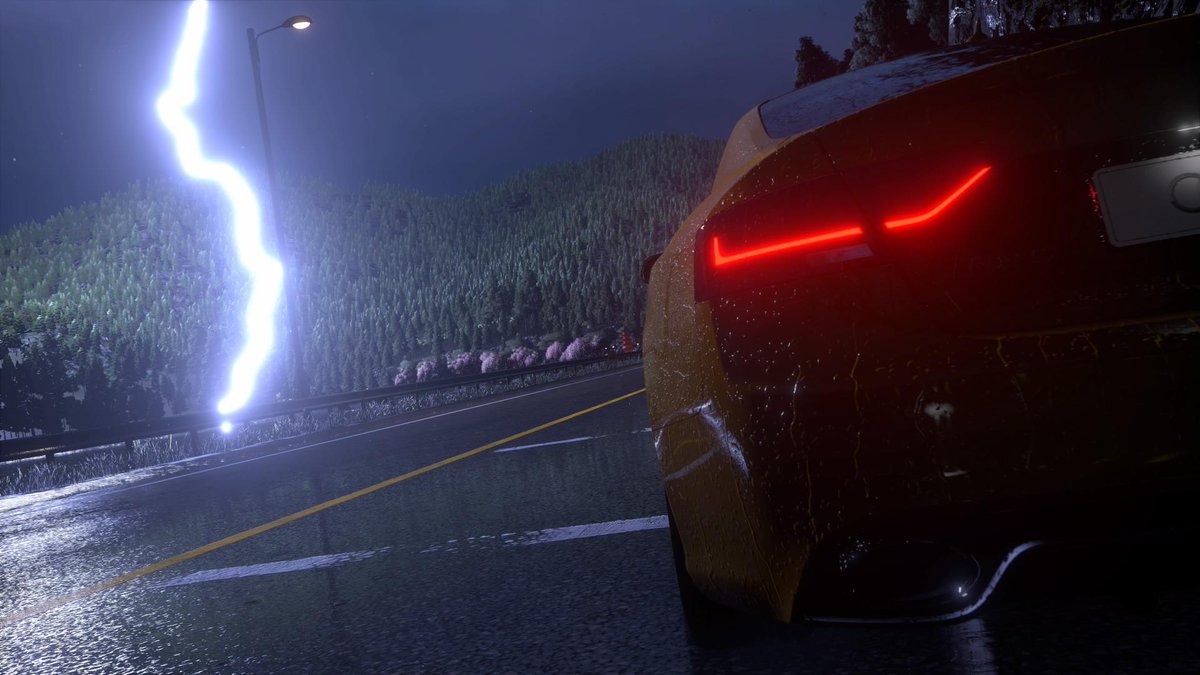
Run a race at dawn in the rain. Watch the world turn gold as the sun comes up. Watch the light stream through the trees and reflect off the puddles. Look at the rainbow over the castle. You won't find anything in gaming much prettier than that at the moment. I'm painting with broad strokes there. The little details really sell it. Headlights from the following cars reflect in rear view mirrors. Water streams across your windscreen as you change direction. Brake lights refract through the water on the lens of the chase cam. Every light you can think of reflects off the road. Spray kicks up as you hit standing water. The world turns momentarily blue when night-time lightning strikes. Light snow touches the bodywork of your car and melts.

What I'm trying to say is that DriveClub has become a joy to look at as well as a joy to play. I spent weeks playing through all the new stuff, and at the end of it all I was only a short grind away from the platinum. This is exactly the kind of trophy hunting I like. Trophies gained by playing through everything the game has to offer, rather than arbitrary tasks that you'd never do in the course of normal gameplay.

With the short grind done (only an hour), and my platinum in the collection, I was done. Over the course of the year, and thanks to many patches, DriveClub has metamorphosed from a game that was at best mediocre into an excellent one that I would recommend to any racing game fan. In fact, I'd go so far as to say it's the sequel to Project Gotham 4 that we never got. It's that good. So try it. Pick it up on the cheap, get the season pass and you have hours of fun on twenty-five quid, and a fairly straightforward platinum to boot.

The only problem for me now is that Evolution went and added motorbikes just days after I thought I was finished with DriveClub. There's some seriously exotic metal in there that really scratches my biker itch. There's a fresh platinum too.

Here we go again.

Saturday, 31 January 2015

What I'd like to see in Zelda WiiU


I've been playing Zelda an awful lot of late, and I've been thinking about what I'd like to see in Zelda when it finally appears on the WiiU. So without further ado, here's a list of the things I'd like to see in ZeldaU.

A ripping yarn
Nintendo made a big step with storytelling in Skyward Sword. Yes it still hinged on the usual kidnap cliche, but in Skyward Sword Link and Zelda had a proper relationship, which meant he had an actual reason to go after her. Let's hope they make another step up in the quality of their stories and give us something epic and properly affecting.
A massive world
A forgone really, since the trailer specifically focussed on an open world. I'd like to see Nintendo go further than that and not just give us Hyrule, but open up some of the rest of the world as well. I'd love the quest to extend to Termina and Kohlint Island. At the same time, the world needs to be filled with life and look like it can support the people living in it.
Towns that feel lived in
I'd love for the places I visit in the next Zelda to feel like functioning communities. In the past, there have been technical limits to how populated a town could be. Hyrule Castle Town in Ocarina of Time for instance felt more like a diorama or a stage set than somewhere where people actually lived. Fable II, despite its faults has this feeling nailed. Bowerstone feels like a thriving community. There was a pub on the Town Square, a blacksmith, food stands, residential areas and shops hidden in back streets. People mingled and complained about their rent. It felt like life went on whether you were there or not. I want to see fields full of grain to feed the population. I want so see trains of cattle from LonLon Ranch being driven to the big city. I want to see people travelling. I want to see people living. Zelda towns exist in a kind of stasis, with people repeating the same lines and motions until the next story beat. For Hyrule to feel like a living world it needs touches like these.
Technology
Hyrule has been pre-industrial for pretty much every game. I'd like to think that the steampunkish monster in the trailer hints at some kind of advance in technology for the world of Hyrule. It would be very cool to see a Hyrule just on the cusp of an industrial revolution. Perhaps one fuelled by the rediscovery and reverse engineering of the ancient technology hinted at in Skyward Sword. A new world where cobbled together old tech sits uncomfortably next to new inventions could be compelling.
Horseback battling
One of my favorite parts of Twilight Princess was charging the Moblin King on the bridge. The horseback battles were some of the coolest and most cinematic moments of the game. I'd like to see them make a return on the WiiU.
Lose the musical instruments
They're annoying and they've become a cliche. Can we have a game without them please?
A day/night cycle
I love being out on Hyrule field and watching the sun set. If the new world of Zelda WiiU is going to feel like a place that could really exist. A day and night cycle is essential.
Motion control
I never thought I'd say this, but motion controls in Skyward Sword made it a better game. It would be a shame to lose them in favour of the gamepad in the new Zelda. Yes, the controls could be improved upon, so let's hope Nintendo do that. It could be amazing.
A separate, playable Zelda  story
Did you ever wonder what Zelda got up to when she was out journeying in Skyward Sword? What about how she became Sheik? Wouldn't it be cool if the next game had playable scenes where Zelda's story got told?
The ability to choose Link’s gender
Lets face it, in most Zelda games it doesn't matter if Link is a boy or not. Think about it. What would change in any game if Link was a girl in any of the Zelda games. Okay, it might lend Skyward Sword a couple of sapphic undertones, but it still wouldn't make any difference to the story at all. There were a lot of positive noises when the trailer for ZeldaU was first revealed and the internet thought that Link was a girl. Let us choose Link's gender. It'd be cool.

Voice work
Come on Nintendo, it's 2015. Let's have some voice acting in your games already. Just not in the vein of, "excuuuse me princess!"
Robin Williams.
Because it would be a fitting tribute to a man who gave so much laughter to the world and loved Zelda enough to name his daughter after her. Credit to http://oscarjoyo.tumblr.com/ for the image


Wednesday, 1 October 2014

The Water Temple


Whilst I’ve been playing Ocarina of Time, one particular location has loomed at the forefront of my mind for every moment I’ve spent inside the game’s world. We all know what I’m talking about, but I’m going to say it anyway.

The Water Temple.

A fabled location of such infamy, that the mere mention of its name can strike terror into the heart of a certain type of person. And whose legendarily fiendish difficulty has given it a second life as something of a gaming folk legend. So it was with no small amount of trepidation simmering in the pit of my stomach that I crossed the threshold of the Water Temple to set about conquering it.

Now, after two hours of sub-aqua adventuring, I can let you in on a secret. The Water Temple isn’t really so bad. It’s not a cakewalk by any stretch of the imagination, but neither is it so impossible that the only way through it is with a guide. I did get stuck once, on a particularly cheeky puzzle that needed the water level raising to the correct level, so that I could blow away an otherwise inaccessible wall to get at a key. But even then it was nothing that five minutes of thought couldn’t solve.

So how did The Water Temple gain its fearsome reputation? At first I thought I’d found The Water Temple so unexpectedly easy because I’d spent so long playing Zelda games this year that I’d started to think like a Zelda level designer. I quickly realised how hubristic that train of thought was and started again. With the exception of Skyward Sword, all of the Zelda games I’ve played this year have been 2D. Then I had a small epiphany.

Let us posit that the average gamer is between mid-twenties and mid-thirties. Using myself as an example, I’m thirty, which puts me at fourteen or fifteen at the original release of Ocarina of time. One’s mind is not a fully formed thing at that age, not really. Think also about the time of the release of Ocarina of Time. We were in the very early age of polygons, and the previous generation of console games were almost exclusively two dimensional.

Like Khan in Star Trek II, we were two dimensional natives thrust into a new three dimensional world where we had had little time to adjust. We had little experience with three dimensional thought. Like Khan, that inexperience would prove to be our undoing.

Puzzles in The Water Temple are about as three dimensional as they could get for the time. They require you to not only think about the effects of your actions on the floor you are on, but also the floors above and below you. Add this to our, at the time, relative inexperience with three dimensional thought and we have the perfect ingredients for a major difficulty spike. We had trouble with The Water Temple because many of us had literally never seen anything like it, so we'd never really had to think this way before.

So, at the time, The Water Temple would have been genuinely difficult. Add this to the collective internet folk memory’s remarkable ability to exaggerate and that’s how I think The Water Temple came about its reputation.

Returning to The Water Temple today after nigh on two decades of experience of 3D gaming, The Water Temple presents less of a challenge. We’re all three dimensional natives now, and we’ve seen and solved hundreds of 3D puzzles in the time since Ocarina of Time was released. Experience is key here. Two decades of thinking in three dimensions, added to the fact that we’re all much older now means that we can arrive upon a solution to a puzzle much easier than we could in the late nineties. That kind of rams home just how innovative Nintendo were with Ocarina of Time. With The Water Temple, they gave us something many of us had never seen before and encouraged us to think in a whole new way to solve the puzzles they had set. There have been others in the time since, but Nintendo got there first, and they did it so well that they managed to spawn a gaming folk legend with their creation.

Friday, 26 September 2014

The neglect, oh dear lord the neglect.

Play it again, Samael...


It’s been a long time, and it’s been so because of the relative dearth of pretty much anything interesting enough to write about as far as gaming is concerned.

“But what about Destiny?” I hear you ask.

Destiny. A bajillion dollar combination of multiplayer FPS, Diablo and marketing blitz that has, unsurprisingly, not lived up to the hype. No thanks. If you love it, then that’s totally okay and I won’t look down upon you for it. But it’s not for me. I’ve been turned off multiplayer shooting for years now, and I’ve never been taken in by loot grabbing dungeon crawlers.

That said, whilst I wasn’t blogging, I did spend sixty-odd hours inside Dark Souls, which you might point out, is a loot grabbing dungeon crawler. And I’d be wrong to disagree with you. But it’s often so much more than that, and that’s what makes it so compelling. Most importantly for me, it’s not a ‘click on the monsters until they disappear’ dungeon crawler in the vein of Diablo.  The superb combat system, combined with the immense challenge, generally forlorn atmosphere and the fact that it’s often  genuinely beautiful means it all adds up to something so much greater than the sum of its parts. And that was what surprised me about it. I gave it a try because it was incredibly cheap and wound up finding one of my new favourite games.

So, I’ve still being gaming, but for the most part I’ve been delving into the collection rather than buying new games, and if I’ve not been gaming I’ve been spending hours with Rocksmith, and I don’t think it’s worth blogging about how bad at guitar I am.

The Year of Zelda is still a thing. I managed to finish Spirit Tracks, even though it was so endearing I didn’t want it to end. The best part about the whole game was being able to blow the whistle on the train any time I wanted. I know that’s a really juvenile thing to say, but every time I pulled on that rope in the corner of the screen, my inner seven year old did a tiny muppet flail. What struck me about the DS Zelda games was that they are Proper Zelda Games, that haven’t been dumbed down just because they’re on a portable with a generally young userbase. The same level of love and attention has gone into them as a full sized console title. Case in point, in Spirit Tracks, the overworld music is tied to the beat of the train. So the faster you go, the quicker the beat of the song. Attention to a tiny detail like that can really anchor you to a game’s world. Other devs take note…

I went straight from Spirit Tracks to my newly returned copy of Minish Cap. There was a certain amount of surprise when I found that not only did my old GBA SP still work, but that my Minish Cap save was still there from the first time I attempted to finish it. I’d expected one or the other to be dead. I was a bit shocked to find that you need to use an adapter to use headphones with an SP though, which kind of put a dampener on things. Still, Minish Cap turned out to be excellent, with an old-school world map that looped and twisted upon itself, while gradually revealing its secrets with continued play. It put me in the mind of a top down Metroid. Add that to classic Zelda gameplay and some stunning 2D art and you have a game that is more than worthy of both your time and the Zelda name.

Ocarina of Time, the big kahuna, was supposed to be next. But I discovered that there is such a thing as too much of a good thing and found myself all Zelda-ed out. So, to tide me over til the release of Trials Fusion, I moved on to Jak and Daxter, generously given to me by a friend. We all know how good a game it is, so I won’t gush too much about it here, but I will say with the exception of a sometimes dodgy camera, Jak and Daxter has aged beautifully and I don’t understand why I’d never played it sooner.

Trials Fusion loomed on the horizon just as events in Jak and Daxter came to an end, and I downloaded it as soon as funds allowed. If you know me, you will know I’m an absolute sucker for anything with the Trials name attached to it. Sadly, Fusion turned out to be a little disappointing. More Trials is undeniably a Good Thing, and Fusion is a very good game, but it doesn’t reach the heights of Trials HD and Trials Evolution. And the reason for that is that basically, it’s just too easy. The barrier to entry has been lowered, which isn’t necessarily a bad thing. And if it means that more people will experience one of the most satisfying games out there then I’m all for that. The problem is the difficulty curve has been massaged to such an extent that it doesn’t offer any challenge to players with experience from the other games in the series.  It took me months to get all golds in Trials Evolution. I’d achieved the same in Fusion within two weeks, with the odd platinum thrown in for good measure. I won’t say that Ubi buying Redlynx has ruined the series, because it hasn’t, but the lowering of the difficulty has pretty much stymied its replay value.  I haven’t been back to Trials Fusion anywhere near as often as I have to Evolution. Bit of a shame really.

At a loss for what to play, I stood back and looked at the collection, going down and down until I found something that jumped out. Eventually my eyes fell upon Discworld Noir. A game that I have blogged about in the past about finding, and one that for some reason had never started. Still, no time like the present, right?  After digging out an RGB scart cable and hooking up my PS2, I found myself looking for the non-existent PS button on the controller to fire it up, which was a bit embarrassing. Still, once I’d worked out how to switch the thing on, I was greeted with what, despite its great age, might be one of the best written, and thanks mostly to the immense talents of Rob Brydon, best voiced games I’ve ever played. Sure, the game itself looks endearingly rubbish, is buggy and i so low-res that you could count the pixels, but it feels like playing a lost Discworld Novel. I loved every moment of it, and if you’re a Discworld Fan, you owe it to yourself to play Discworld Noir. I really can’t recommend it highly enough.

A stint with the utterly sublime Sly Cooper followed while I tried for some reason to put off going back to Zelda. The vintage Warner Brothers cartoon does Ocean’s Eleven styling still looks great and the game itself provided ample distraction from the fact that I should have really been playing Ocarina of Time. Thankfully, during that time, I finally got my GameCube back from my sister and with it, my proper copies of Wind Waker and Twilight Princess, none of that HD remake or waggly Wii port nonsense for me. With that, there was no excuse. I had to start Ocarina of time. I hooked up the N64 using my GameCube composite lead (yes I know I should have an RGB conversion, but anything is better than a co-ax cable) and dived in.

Now I’m dreading going to the Water Temple, but loving every minute of the time I’m spending in Hyrule. Yes, the save system is Mesolithic, but while I’m surrounded by chunky 90’s polygons, muddy N64 textures and sound so lo-fi its almost cute and I find myself thinking that sometimes, this is all I need. So what if new games aren’t interesting at the moment. I have a massive back catalogue that’s full of good stuff. I don’t need a new gen console yet, and as it turns out, there are plenty of interesting games. They’re just not new ones.

Sunday, 23 February 2014

Further (spoiler filled) Adventures in Hyrule


The year of Zelda continues apace, and I have found myself in a peculiar situation. I've been playing what count as chronologically the first and last stories of the series. Last week, I'd been leafing through the Legend of Zelda Wikipedia page and happened upon the official timeline of the world of Hyrule. It's interesting to say the least. Especially at the point of Ocarina of Time, where the timeline splits into three separate branches. Closer inspection revealed Skyward Sword to be the first story and Spirit Tracks as what could subjectively be called the last. Starting as I have with Skyward Sword, I've decided to compete the games in the chronological order as best I can. So that means Minish Cap will be next.

That means, of course, that I have finished Skyward Sword. And it was utterly fantastic. It's the best Zelda game I've played by quite a long margin and possibly one of the best games I've ever played full stop. First of all it's gorgeous. It really does look like a painting in full motion. The poor little Wii must have being straining as hard as it could to push those visuals down the component cable. It played beautifully too, with the 1:1 swordplay and subtly polished battle system being the highlight. I loved how the world has been cut down to four main areas, with new areas opening up with repeated visits. Story wise, Zelda games have long been the black sheep of Nintendo's line of titles, shot through as they are with an undercurrent of sadness that you don't often see in their other games. Skyward Sword is no different, in fact the line of sadness probably runs deeper in this game than any other.

The more you play, the more there is to be a touched by, from the grand tragedy of Impa's thousand year vigil, alone in the sealed grounds, likely kept alive by the power of the gate of time or the power of the goddess, only to fade away to nothing when her task is completed, to the small tragedy of Beedle living all alone on an isolated island with nothing but a beetle for company.  It's everywhere you look. I found myself looking in on Pipit's problems at home and wondering what happened to the rest of Batreux kin, or what had turned him into a monster and what he had done to deserve it. Then there was the part I had in breaking the hearts of both Cawlin and the item check girl. There was no way to let her down gently, and that's what made it worse.

The most surprisingly sad events surround the fate of the ancient robot civilisation in the desert, seemingly immortal consciousnesses trapped inside non-functional bodies, unable to act as they watch their verdant homeland turn to desert and their civilisation crumble around them. Press the A button while stood next to one in the present and they will try and talk to you. Activate a time crystal in their vicinity and they will be fully functional and pottering around as if nothing as happened. Deactivate that time crystal and you will see them shut down and deteriorate right before your eyes. In most games, this would just be detail, but in Skyward Sword, the little robots are so damned endearing that you really do feel sorry for them. I found myself hoping that after the ending, Scrapper the robot left Skyloft and returned to the Lanayru Desert to repair his kin and rebuild the lost robot Civilisation.

Then there were the unanswered questions. Where are the rest of the Gorons. What was the lost civilisation that created the Goddess Sword like? There are stories everywhere in the gameworld that sound like a relatively primitive civilisation trying to make sense of technology so advanced that it is indistinguishable from magic. Take Fi for instance. She is obviously some sort of powerful artificial intelligence. I'd love to see Nintendo go further back into Hyrule's past and explore the first civilisation.

Finally, and most tragic of all is the tearful goodbye between Zelda and Link as she seals herself away to keep the bonds of The Imprisoned intact. Link and Zelda have a real relationship in this game. She's not just a princess to be saved. It meant that Link actually had a valid motive to go after her and gave every interaction between them genuine warmth then made their eventual reunion all the more powerful when it finally happened.

Skyward Sword is a masterclass from beginning to end. The game that finally justifies the Wiimote. The swordplay is just fantastic. It's amazing how Nintendo have managed to make the way Link wields the titular sword look so natural. It could easily have made Link look like a puppet. The game has one of the series best antagonists and an ending that ties every game before it into one recurring Narrative and shifted the way I perceived the series as a whole. They are not just individual stories tied together by common threads anymore. Just as in Bioshock, wherein there is always a Man and a Lighthouse, in The Legend of Zelda there is always a Boy, a Princess and the ancient evil that follows them.

Long may the cycle continue.

Wednesday, 15 January 2014

The Year of Zelda


I got a Wii for Christmas.

Yes, I'm a bit late to this particular party, but then when it comes to Nintendo home consoles I always have been. I'm not much of a Nintendo fan by any stretch of the imagination. Those who know me or have read the blog know of my complete ambivalence to anything with the name of a certain mustachioed plumber attached to it. However, that doesn't stop me enjoying the rest of what their consoles can offer. I have an N64 and a Gamecube, and I've also owned a version of every Nintendo portable since the Game Boy Colour.

My Nintendo consoles add flavour to the more mainstream portions of my gaming diet, like a delicious chocolatey desert compared to the meat and veg of Sony or Microsoft. I may not be bothered by much in the way of Mario, but that still leaves delectable treats like Zelda, Metroid, Smash Bros, F-Zero, Star Fox and Wave Race to dance upon my palette.

I asked for a Wii to replace the Gamecube pinched by my sister and specifically to allow me to play two games. Metroid Prime 3 and Zelda: Skyward Sword. Sure there are other games worth playing on the Wii, and I have a list of titles to find, but it's those two that sold the system to me, and prices have dropped to such a level that I can justify buying a console for two games now. If I'm honest, I wanted the Wii just for Zelda. It's by far the best thing Nintendo have in their arsenal.

I came to Zelda late. Dad bought a Nintendo 64 and Goldeneye for reasons that still aren't quite clear. I liked Goldeneye. It was fun, but it was a loan of Ocarina of Time that really pulled me in. I wound up buying it, and Majora's Mask and I still have them. They started a late blooming gaming love affair that I'm always happy to go back to. I bought my missing GameCube to play Wind Waker and hunted down a proper copy of Twilight Princess as well. None of that waggly right handed Link nonsense for me. Outside of my two big-boy consoles, my portables have provided Link's Awakening, Minish Cap and most recently Phantom Hourglass and Spirit Tracks.

The times I actually play the games are pretty few and far between, and I always get them way after release, but I always enjoy them even if it takes actually playing a Zelda game to remind me of that. The most recent entry to do this has been Phantom Hourglass. Up until last week, I hadn't played a Zelda game since the year Twilight Princess dropped. Hourglass really got its claws into me and reminded me why I love this series so much. It also had me reminiscing, and it dawned on me that although I own a lot of them, I've actually only finished two Zelda games - the GameCube ones.

Clearly this is Sacrilege of the highest order, so I've decided to take inspiration from Nintendo's Year of Luigi to have my own year of Zelda. I'm going to play and complete as many Zelda games I possibly can. And if I can, I'm going to do it on the original hardware. There won't really be any order of play, but as a Gamer, I feel like this is something I owe to myself to do. So, once Phantom Hourglass is done, Skyward Sword will follow and after that, who knows? It's going to be a great opportunity to break out old consoles and right past wrongs.

In the process, I'll have to find another copy of Minish Cap, since mine was 'borrowed' by my sister, and work out how I'm going to play The Legend of Zelda, Adventure of Link and Link to the Past without paying through the nose for them. I've never owned a NES or a SNES so I've never played Link's first three games. In fact, I don't even think I've ever seen those game's carts. I get the feeling that going back to those games might be something akin to digital paleontology. It's going to be very interesting.

This is a proposition of epic proportions, and there's every possibility that I might be doomed to failure. Still those who don't try don't win, do they?

So to quote Celebrity Deathmatch, let's get it on!

Wednesday, 8 January 2014

It's the end of the world as we know it.


It's Grim out there. With a capital G. Britain is flooding, sirens are sounding the breach of Chesil Beach, and on the other side of the Atlantic, North America and Canada are gripped by a blast of arctic air that will freeze your breath in the air as soon as it leaves your face. If I were a Viking, I'd be saying Ragnarok is upon us.

Of course, the world isn't ending, but we are in January. Grimmest of all the months. We're all broke because we spent all our money on Christmas. We go to work in the dark and come home in the dark. The only sun we see is through the workplace window, if we're even lucky enough for that. It's cold, it's wet and we're all miserable because we're starving ourselves on post Christmas diets.

January is rubbish, and the moods it inspires in some people seem to have permeated the games I've been playing of late. Truth be told, this started before January, but I'm in the middle of a run of some of the bleakest, saddest games I've ever played. It started with Tomb Raider, where Lara gets beaten senseless by her surroundings as she tries to escape a weather beaten island somewhere near Japan. There's a complete absence of hope for a lot of the first half of the game. Lara is a lamb thrown to Yamatai's wolves. Playing it is draining.

In a bid to brighten things up after Tomb Raider was finished, I got Brothers: A Tale of Two Sons. The demo was bright and breezy and thoroughly enjoyable, but it concealed the full game's dark heart. I covered this in my last post, but it bears repeating. Brothers may be my game of 2013, but good lord is it sad. Every moment of levity is brought crashing down around you by some kind of  tragedy just minutes later. The game eventually builds to the saddest thing I've seen on screen since the first fifteen minutes of Pixar's seminal Up. After that, I just decided that games didn't want to make me happy at the moment and got stuck into the next.

The next game wound up being Deadlight, which I downloaded in trial form upon release and forgot about. It popped up for under two quid in a post Christmas sale on XBLA with Flashback and I Am Alive, so I decided to get the full version. Deadlight turned out to be a sort of cross between Limbo and The Walking Dead set in the 80s. While the story was a bit generic Zombie Apocalypse, it was well told and looked fantastic. The mood was consistently downbeat though, and while I enjoyed it, there wasn't a lot to smile about while playing it. Once the tragic ending had played out and the credits rolled I dived straight into I Am Alive, a sort of Assassins Creed meets The Road kind of game. It's the greyest thing I've ever played and I put it down after getting to the protagonist's flat. All the end of the world was getting too much.

Still, I'm a sucker for punishment, so Metro: Last Light is in the disc tray at the moment. I'm a fan of the first game, and a fan of the concept and the fiction in general. I don't think a post apocalyptic civilisation has ever been better portrayed in anything than in Metro. It's such a coherent universe, and pretty unique in western gaming. It's developed by Ukrainian team 4A and based on a Russian sci-fi novel of the same name. Metro is so convincing, and I think it's because of its Ukrainian origin. As anyone who's heard about Chernobyl knows, the Ukraine has first hand experience of what it's like to be on the receiving end of a nuclear disaster, and if you look at any photos of Chernobyl you can see how the place has influenced the aesthetic of the post Armageddon Moscow surface. Most of the game takes place in the populated tunnels of the Moscow Metro, and it's uniquely creepy. The best worst moment so far has been the flashback to ground zero on the day the warheads fell from the perspective of the crew of a flight back from Majorca. If you've never played it, click the link and watch it. You need to see it. Metro: Last Light is proving to be fantastic at the moment, and is a definite improvement on the previous game, but it's still pretty grim and I've been needing to something brighten up the winter darkness.

Enter Zelda: The Phantom Hourglass. It may be a game about sailing over the sea that's flooded a long dead civilisation and therefore in keeping with the Grim January theme, but it's so happy about it that it's not something you think about when the gulls are wheeling above your bows while you hunt for treasure. I'm pretty late to the DS Zelda games, but in a month like January, I'm happy that I have them. Say what you like about Nintendo, you can always count on them to brighten up a cloudy winter afternoon, no matter what your gaming tastes.

Here's to you Link!

Thursday, 2 January 2014

It's the New Year, and the Blog is Back!

The blog is back! A house move, a month long internet drought, a complete dearth of any new games and the loss of my writing mojo added up to my terrible neglect. So, what bought me back?

New games of course. I'd finally got some cash together, and fortuitously, found a lot of great games at extremely good prices. After leaving the 360 in a corner until mid December, I spotted Call of Juarez: Gunslinger going cheap on XBLA. Purchase made. Tomb Raider and Metro: Last Light followed soon after when I snuck them into the trolley during the Christmas food shop. Gunslinger turned out to be fantastic, especially since I only downloaded it because it was cheap. With a great narrator, and some clever narrative tricks of its own, it felt like playing a cross between Bastion and top quality Sergio Leone movie.

Tomb Raider followed shortly afterwards and it was truly excellent. Rhianna Pratchett and Crystal Dynamics have somehow achieved the impossible. Firstly, they've turned Lara Croft into a normal human being who gets thrust into an incredible situation and is forced into some incredible actions. Secondly, they have made a game that can do the ancient tombs and spectacle that Uncharted does so well, without it feeling like an Uncharted clone. It did put me through the wringer though, and I decided I needed something whimsical and nice before I plunged into the famously grim Metro: Last Light. So, on the 30th of December I paid for Brothers: A Tale of Two Sons. By the 31st of December, it was my game of the year.

Brothers came across in the demo as mixture of Ico, Journey and Fable, a sort of co-operative single player game set in a pre-industrial fairytale village. It felt light and whimsical, and it was beguilingly beautiful, exactly what I needed after the emotional gauntlet of Tomb Raider. I got one over on the local bully, I played catch, helped a rabbit win some friends and met a helpful troll who threw me over a crevasse. The demo ended and I decided that I needed to own this game. Funds were tight though and I had to put off buying. Then it showed up on XBLA after Christmas for a pittance. Decision made.

After purchase, Brothers quickly revealed something else, the whimsy that I loved was tempered by a Limbo-esque dark heart. The game begins with a traumatic flashback and opens for real with one of the titular brothers knelt at a gravestone. From there, the tone stays dark, with you wheeling the brother's father to a doctor in a cart. According to the doctor, the only way to save him is with water from the tree of life. Cue an epic Journey across a vast and diverse world. The brothers visit a mine, traverse an ice filled river, cross a forest with only a flaming torch for defence, visit a vast castle, cross a very special battlefield, and work their way through an arctic village. You have to work the story out yourself. The language of the game is entirely fictional a-la Ico but in a clever twist, is not subtitled. Thankfully the stellar characterisations help making sense of the story simple, and many of the events would be universally understandable whether there was language or not.

There are betrayals, rescues and romance. There is levity, wonder and grief. Every vista is beautiful. There is spectacle everywhere in this game, but it's nothing like the bombast of something like Tomb Raider. Brothers wants to show you beautiful things. It wants to make you gasp and smile. It wants you to experience childlike wonder with every discovery. However, every moment of joy is hard won and often tempered by a crashing comedown. There is tragedy in this world, some of it directly connected to the Brothers, some of it around them. It all adds up to one of the most beautiful, affecting and genuinely sad games I've ever played. Like The Walking Dead, Brothers is a rollercoaster of emotions and it will stay with me for a very long time. The ending was especially poignant, and marks the first time ever that I've welled up at a game. It wasn't a full blown cry, but the eyes definitely weren't dry.

If you like any of the games I've compared Brothers to, you owe it to yourself to play this game. If you like indie games, you owe it to yourself to play this. Same if you do the games are art thing or if you like a good old cry. Actually, you should just play this. You can't afford to miss it. It's really that good.

Game of the year 2013.

Wednesday, 9 October 2013

Banjo-Kazooie: Not quite the classic I was led to believe it was.


So, after over twenty hours, numerous obscenities and a little bit of gamer rage over a major instance of arbitrary injustice, I have finally beaten Banjo-Kazooie. The overall impression? If I'm honest, a little bit of disappointment, a little bit of relief. I may have been expecting a bit much. Banjo has been lauded from most corners of games journalism and the internet as a classic, and I'm sorry, but it just isn't. It may have been a shining example of the genre when it first dropped fifteen years ago, but today, not so much.

An admission: I never played Banjo-Kazooie when it first arrived. I was a PlayStation owner for most of the late nineties, and by the time I finally got my paws on an N64, prices for Banjo had gone through the roof. I eventually got the game with a free download code when it was released for XBLA a couple of years ago. But, shamefully, I let it languish in the depths of the hard drive until I began living out of boxes a week or two ago, having packed almost everything I own for a move that has wound up being delayed. So with no physical games to play, I began to plumb said depths of  hard drive and play some of my XBLA backlog.

After polishing off the thoroughly satisfying Alan Wake's American Nightmare, Banjo was next on the list, and I dove into it with gusto. The first two thirds of the game were a lot of fun, but at about the point of Rusty Bucket Bay, the game started to become a slog. Eventually I got to the point where the only reason I was continuing was to not let the hours invested up to that point go to waste. Banjo-Kazooie, for the most part, is a good game but it's held back from greatness by a couple of regrettable flaws.

I liked

The art direction: As I've said before, the quality of a game's art will directly affect how well it ages. Banjo-Kazooie is fifteen years old, and it looks it. But that is not to the game's detriment. It's bold, chunky and colourful, and remains very easy on the eye, despite the well documented texturing problems of its original platform. The game world is coherent and absolutely everything looks like it belongs there.

The personality: Everything has a face. Everything. From the witches broom, to the cauldrons scattered around Grunty's Lair, to the vegetables hopping around spiral mountain. On top of that, each world has it's own unique cast, each with it's own unique voice and personality. It gives the whole game a whimsical, storybook feel that makes it a pleasure to spend time with.

The first two thirds: Banjo-Kazooie began as a very enjoyable game, and was balanced just nicely enough that its flaws didn't get in the way of the fun. Sadly, upon arriving at Rusty Bucket Bay, that all changed. The difficulty suddenly spiked, and the controls, camera and collision detection just couldn't give the accuracy that the higher difficulty required. Where once the game was challenging, now it was needlessly difficult and the fun just drained away.

I disliked

The camera: Let's get this out of the way first. The camera is bloody awful. Yes, the game was developed in the nineties, but it's bad even when compared to other games of that vintage. The main problem is the alarming regularity with which it gets stuck on the scenery. Or it will swap sides at random, inopportune moments, causing poor Banjo to fall to his death. Added to this is the fact that the camera seems to have a minimum amount that it will pan at the touch of the right stick. This meant that I couldn't pan the camera the tiny bit that was needed to make sure the perspective was right for some of the more difficult jumps later in the game.

The loose controls: In and of itself, this wouldn't be a problem. There are plenty of games out there that have loose controls that feel great, and for the most part, Banjo-Kazooie is one of them. However, later levels need a level of precision that the controls just aren't able to give, which makes already difficult levels even harder.

The iffy collision detection: Again, not much of a problem until the later stages of the game. But by then it combines with the bad camera and overly loose controls to infuriating and maddening effect. I lost count of the times Banjo fell to his death because of a deadly combination of a dodgy edge and a slightly less than perfect jump.

The collectibles: One hundred jigsaw pieces, nine hundred musical notes, forty five Jinjoes, red feathers, gold feathers, mumbo tokens, eggs, caterpillars. Need I say more?

Being dumped on the ground floor of Grunty's lair after loading: Would it really have been so hard to just start the game from the last floor I was on? Traipsing through the castle every time I started the game was an exercise in needless frustration.

The quiz at the end: Arbitrary and annoying. It should not take three hours to cross a room that it would take five seconds to cover if there wasn't a boardgame in the way. The idea in itself isn't a bad one. But instant death on certain squares if you get a question wrong is just bad design. After over thirty retries I almost put the game down and deleted it.

Despite all the ranting though, and the fact that the last three levels were the kind drudgery that would make even Sisyphus feel sorry for you, for the most part, I still enjoyed my time with Banjo-Kazooie. It was whimsical and nice, even when it was testing my patience to the very limit. It wasn't the classic game I was looking for, but I'm glad I played it. It's sort of a badge of honour to say you hundred-percented Banjo Kazooie, and now that I know why, I'm proud to wear it.

I shall now be spending a bit of time with Beyond Good and Evil HD before starting Banjo-Tooie. Hopefully Rare will have tightened things up a bit for the sequel.

Wednesday, 25 September 2013

Call me Ishmael.

Not quite what I'm on about, but it fits the analogy quite nicely.

I've done it! I have harpooned my white whale. Although unlike in the famous novel from which the expression is taken, I have survived to tell the tale.

The gaming Moby-Dick to my Ahab is an incongruous one. A classic MegaCD game, purchased eighteen years ago from a bargain bucket in a ratty Cash Converters. It's hailed as a classic now, and fetches mega money on eBay if it's in good condition. You might know it as Sonic CD.

Over the years, although I cherish owning it, I've come to love and hate Sonic CD in equal measure. It's become a symbol of both my early good taste, and my complete inadequacy at certain kinds of game. I love it for its great soundtrack, its opening cinematic, its time travel mechanic. I even love it for giving us Amy Rose and its retina scorching special stages. I hate it for one infuriating, annoying, impassable level. Stardust Speedway Act 3. Or as those who haven't played Sonic CD know it, the level where you race Metallix.

How on earth is it possible that I became stuck on that one level for eighteen years? I don't know. The difficulty was extreme. The idea is that you race Metallix through the level to Amy, while all the time, you are chased by Robotnik in the Egg-O-Matic who is sweeping the ground behind you with some kind of terrifying beam weapon. Touch it and you die. Lose to Metallix and get shut out of the safe area at the end of the level, you die. Get too far ahead of Metallix and he chases you down with a charge attack. If you get hit by it, you lose not only rings, but valuable momentum. Then you get hit by the beam and die. On top of all of that, there are a whole slew of momentum killing obstacles and spikes, which, surprise surprise, make it really easy for you to die. I've played that level again and again, sometimes losing by just tenths of a second. I bashed my head against it from the time I bought the game until my parents bought me my PlayStation the following Christmas.

Over the following years, nostalgia, and a sense of burning injustice at the state of the universe led to a cycle of me periodically breaking out my MegaCD and trying my luck on Stardust Speedway Act 3. And every time, my patience would slowly get ground away until the only alternative to throwing my MegaCD over a motorway bridge was putting it away and trying my hardest to calm down. The cycle continued until I gave up altogether, and let go of all hope of ever getting to the end of the game sometime around 2008. My MegaCD remains boxed up, with that incomplete save, laughing at me from the top of my wardrobe.

"But," I hear you ask, "how on earth did you finish it, if  your save is still incomplete?" The answer of course is a re-release.

Sonic CD popped up on XBLA, and like an idiot, I downloaded the demo on release day. I liked how they'd updated it, but still kept the game underneath intact. It was widescreen, a couple of slowdown bugs had been fixed but those were really the only differences. Continuing to be an idiot, I bought it, thinking that perhaps the game had been rebalanced, and that this time around, things would be different.

A few hours later I got to Stardust Speedway Act 3. Things were no different. Moby-Sonic breached the waves with alarming aggression, sailed gracefully through the air and crashed down through the rigging of the ship of my hopes and dreams, smashing it to matchwood.

Sonic CD had defeated me again, and went back to being left in the vaults unplayed.

This was a state of affairs that continued until last week. I'd found myself bereft of games after packing everything up ready for my move. All that is left to play is what is inside my 360. And pretty much the only uncompleted full game in it was, you guessed it, Sonic CD. Faced with this unfortunate reality, I resolved that once and for all, that I would beat this goddamned game if it killed me. Cue two hours of furious, swear filled retries of the same two minute level. I lost count of the amount of times I ran out of lives, loaded my save and kept going. Which was something which was impossible on the MegaCD version. If you ran out of lives, your save took you back to the first act of the zone. In the end, after two hours of total, complete and utter failure I got lucky. A mistimed jump became one of those fortunate accidents that eventually become the stuff of legend. The number of pixels between me and my metallic nemesis as I passed the finish line could have been counted on one hand. But it didn't matter. I actually cheered, out loud, as eighteen years worth of failure and anguish poured out of me. I'm not sure it's actually possible to put a measure on the elation of that moment.

I had vanquished my white whale, and went on to complete the game on the same night. The final boss was curiously easy. I beat it at the first attempt. However happy I may have been though, the game still had the last laugh. I didn't have all of the timestones, and had to watch Dr. Robotnik fly away with them in the ending cinematic.

As far as I was concerned though, that didn't matter. The timestones could wait. I'd just beaten a game after eighteen years of trying.

Dreams can come true.

Thursday, 19 September 2013

Well, this beats smack talk and shooting.


Another blogpost and another excuse for it being late.

I've been too busy playing games. Specifically one game. Magic the Gathering 2013. In a surprise twist of fate, Magic 2013 has turned out to have been one of the best free downloads I've ever been fortunate enough to come across. Say what you want about the age of the games Microsoft's Games for Gold programme, (and some of the games have been old) this old game was totally worth it. Not for the gameplay though, but for the experience of playing it with some of the friends for whom it happens have moved to abodes that are far from my own.

We took up Magic just after we finished college in 2002. It suddenly strikes me that that was ten years ago, but I digress. We played as often as we could whilst various members of the group worked rubbish jobs or slogged their way through university and enjoyed the whole thing an awful lot. We even went as far as holding a booster party, and at one point I spent upwards of fifty pounds in a futile attempt to build an unbeatable deck of the Bringers of the Five Dawns. Eventually though, people got better jobs, or finished university and moved away. The cards went back in the Half Life 2 Limited Edition tin and were broken out once in a blue moon out of nostalgia.

That all changed about six months ago with a random Magic based post on Facebook from a far flung friend with whom I had effectively lost contact. I commented on her post and eventually we wound up playing Magic over Skype while having a right old catch up at the same time. I lost miserably, but the experience was fantastic. I'd not only renewed a dormant friendship, but had also sparked my long dormant interest in Magic back to life. After then I played a few games more locally with friends and the spark remained. We weren't playing obsessively, but it was good fun all the same.

Then September rolled around and Magic 2013 came up as a free download. I contacted some of my old Magic playing friends to attempt to coax them out of card gaming retirement and we all downloaded it out of curiosity to see what it was like.

I have never had a better time playing online with friends as I have playing Magic 2013.

With everybody being apart and doing their own things now, getting us all together in one room can often be something akin to herding cats, but Magic 2013 has given us a way to spend some meaningful time together and just catch up without having to pull everyone into one room. The game itself is almost secondary. Without the high intensity environment of our usual go-to multiplayer games like Project Gotham 4 or Left 4 Dead, we've actually got time to chat with each other like civilised people, rather than calling bullshit on a dodgy overtake every five seconds. One session was enough to convince us that this was the best thing online since the invention of the mute button and we just kept playing. We're up to two nights a week now and have gotten to the point that we're considering spending money on expansion sets to switch things up a bit. The conversation is great, and the competition helps to add a little bit of spice to the sauce.

I even managed to convince my Skype Magic playing friend to get in on the action. She bought a gold subscription specifically to download the game and on Tuesday we spent the best part of five hours just playing and chatting. It's what online gaming should be all about; getting your mates together and chewing the fat like you were ten years old, sat on the floor in your parents' living room. Which is basically why I got the 360 in the first place. It's become my favourite way of keeping in touch with my friends.

Magic online is absolutely worth the price of entry, even though it's not free anymore. Skype is good, but it's only one to one. If you're a long way from home and you want to spend time with a group of friends without hopping on a train or a plane, there really is no better way of doing that than with an evening session of Magic.

Trust me on this.